
Talks held in Geneva between 9 and 12 May between delegations headed by Treasury Secretary Scott Bessent, US Trade Representative Jamieson Greer and Chinese Vice Premier He Lifeng resulted in a significant de-escalation in the trade war between the US and China. The US will now impose 30% additional tariffs on imports of goods from China, down from 145%, and China will impose 10% additional tariffs on imports of goods from the US, down from 125% (see Chart 1).1
Latin America Series – Central Bank Update
Global economics and policy trends
2 min read
US and China climb down tariff ladder, outlook remains uncertain
Trade talks in Geneva resulted in a temporary reduction of 115 percentage points in reciprocal tariffs between the US and China. In this Macro Flash Note, Economist Sam Jochim discusses the outlook as the US and China take the first steps down from the trade war ladder they had been climbing.
Chart 1. Additional tariff rate imposed by US and China on each other (%)
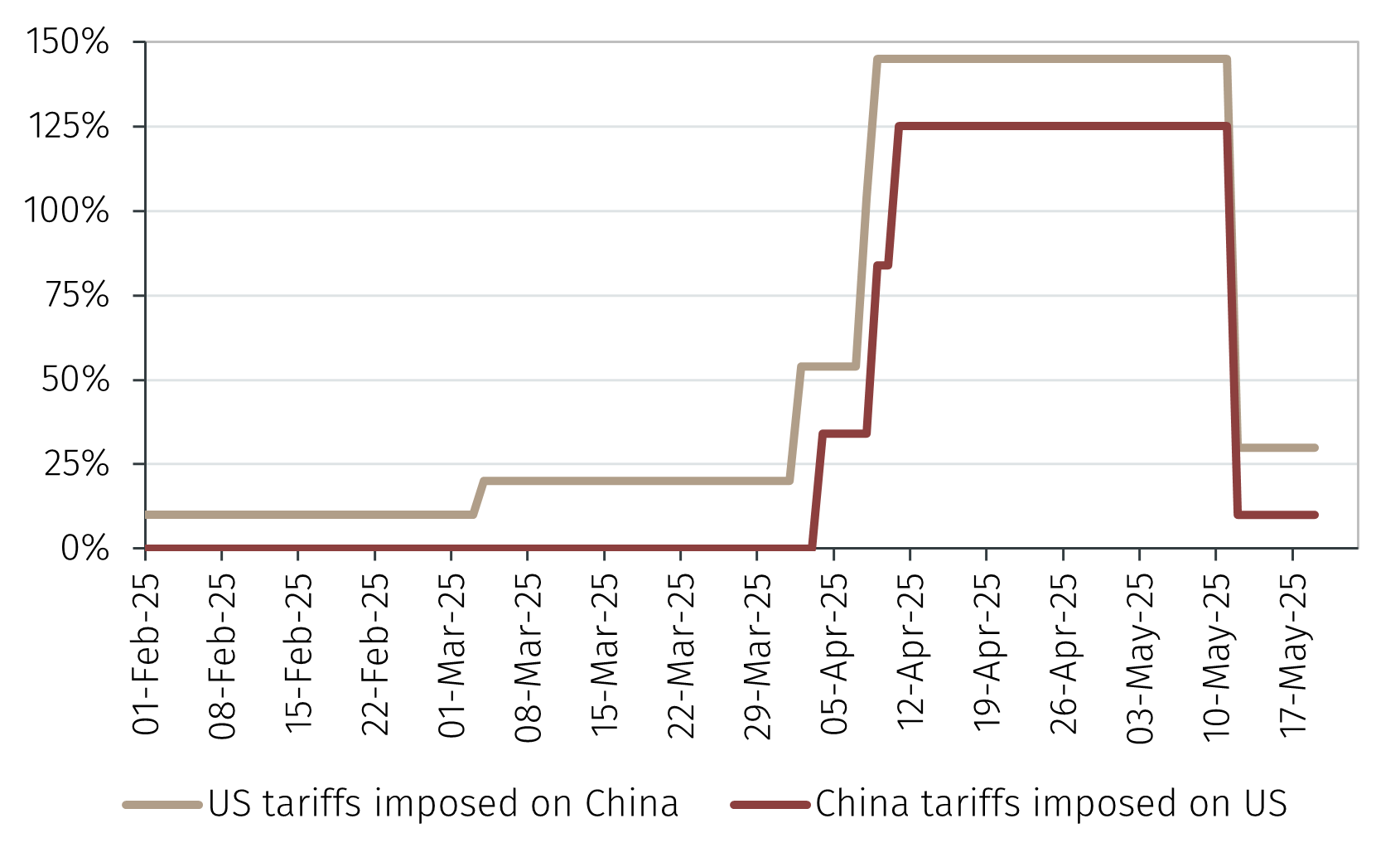
Source: White House, Financial Times and EFGAM. Data as at 19 May 2025.
The lower tariff rates will remain in place for an initial period of 90 days, during which time a broader deal should be negotiated in the hopes of reaching an agreement similar to the one announced on 8 May between the US and UK. The agreement represents a meaningful step down from tariff rates that were so elevated they were, in the words of Scott Bessent, “the equivalent of an embargo”.
The market’s interpretation of the agreement reflects an improvement in sentiment and reversal of some of the initial declines which followed “Liberation Day”.2 Equity markets have moved meaningfully higher, with the Hang Seng and S&P 500 up around 2.1% and 5.3% respectively from the announcement on the morning of 12 May until close on 16 May. Although the S&P 500 outperformed the Hang Seng in the week announcement, the latter has outperformed the former by 15.1 percentage points year-to-date.3
While the recent developments mark a clear step in the right direction for the US-China relationship, attention will soon turn to what will happen at the end of the 90-day period. Uncertainty will remain until there are further details on the potential for a broader deal and the conditions expected in the case of such an agreement. It is likely that any agreement from the US will be conditional on China committing to increase its purchases of goods from the US.
One significant positive is that the wording of the joint statement from the US and China implies that even if the 90-day pause expires and tariffs are raised, they won’t go back to 145% and 125% respectively. Instead, both countries would raise tariff rates on each other by 24 percentage points, taking the US tariff on imports of goods from China to 54% and the reciprocal rate imposed by China to 34%. While this outcome would be worse than where we are now, it would still be better than where we were a week ago. This represents an implicit acknowledgement by both governments that the previous regime was unsustainable.
However, Trump’s first term as US President should serve as a warning that we are not yet out of the woods. After similar tit-for-tat tariff impositions at the start of 2018, the US and China agreed to avoid a trade war and China agreed to substantially reduce its deficit with the US by increasing imports of agricultural and energy goods. A month later, Trump went ahead with tariffs on China and the trade war escalated significantly.
While a repeat of these events may not play out, it is a risk to be aware of and raises a broader point. The conclusion of talks between delegations from the US and China over the weekend should be viewed as the end of the first lap rather than crossing the finish line. Although recent developments have been positive, uncertainty over the US’s trade policy remain high. The fickleness of Trump’s tariff policies so far may have caused long-lasting damage to the US’s reputation as a global partner and investment destination.
1 https://www.whitehouse.gov/briefings-statements/2025/05/joint-statement-on-u-s-china-economic-and-trade-meeting-in-geneva/
2 https://www.efginternational.com/uk/insights/2025/tariffs-worse-than-expected-uncertain-outlook.html
3 Based on local currency return data as at 16 May 2025. Source: LSEG Data & Analytics and EFGAM calculations. Past performance is not indicative of future results.